Planning a family trip to Jordan? Amman is more than just the place where you land before heading to Petra. Here’s our first-hand guide to visiting Amman with kids, including the best things to see, what to eat, where to stay and the practical questions families actually want answered.
Amman is not a city that reveals itself all at once.
Spread across a seemingly endless collection of hills, the Jordanian capital can feel chaotic, noisy and slightly bewildering when you first arrive. But give it a little time and you discover a city where ancient Roman ruins sit in the middle of modern neighbourhoods, colourful markets spill into narrow streets and some of the best food comes from very unassuming little restaurants.
And for families, there is a bonus: Amman is rather easy to enjoy with children. At least this is how we experienced it after settling in.
We spent two nights in Amman at the beginning of our Jordan adventure before setting off by car towards Petra. Rather than trying to cram every attraction into one exhausting sightseeing marathon, we explored the city on foot, ate our way through Downtown and simply enjoyed seeing how Amman works.
And yes, there was plenty of food involved.
Watch our full Amman experience here: Tour of Amman, Jordan — Must Try Food in Amman!
Is Amman worth visiting with kids?
Absolutely.
Many visitors treat Amman as little more than an arrival point before heading straight to Petra or Wadi Rum. That would be a shame.
Amman has enough history to keep older children interested, enough street life to entertain younger ones and, most importantly in our experience, plenty of opportunities to stop for snacks.
The city is also a useful introduction to Jordan before embarking on the bigger adventures elsewhere in the country.
The official Jordan Tourism Board describes Amman as a city where modern buildings, restaurants and galleries sit alongside traditional coffee shops, markets and historic sites. That mixture is exactly what makes it interesting.
The only thing you need to remember is that Amman is hilly.
Very hilly.
If your children are still small enough for a carrier, take it. We did — and it was one of those travel decisions that turned out to be considerably more useful than whatever we had packed “just in case”.
How many days do you need in Amman?
For most families, I would recommend 1–2 full days in Amman.
With one day, you can comfortably see the Citadel, Roman Theatre and Downtown, with time for some local food.
With two days, you can slow the pace down and add Rainbow Street, Jabal Al Weibdeh, the Jordan Museum or one of the city’s many food experiences.
We spent two nights in Amman, which worked particularly well because it gave us enough time to explore without making the children feel as though they were being marched from archaeological site to archaeological site.
If you’re using Amman as the start of a Jordan road trip, two nights is a particularly good introduction.
Where to stay in Amman with kids
We stayed at Wild Jordan Center, which turned out to be a fantastic base for our short stay.
The location was one of the biggest advantages, with spectacular views across Amman’s Old City. Our accommodation was a small studio apartment, which gave us a little more flexibility than a traditional hotel room.
The Wild Jordan Center is run by the Royal Society for the Conservation of Nature and is particularly well positioned for exploring the Jabal Amman area.
For our family, we prioritise:
- A central location
- Easy access to delicious local restaurants
- A room large enough for everyone to sleep comfortably and have some private space
- A good view — because Amman’s hills are part of the experience
- Easy access to taxis or parking if you’re road-tripping
The city is spread out, so staying somewhere central can save a surprising amount of time.
Best things to do in Amman with kids
1. Explore the Amman Citadel
The Amman Citadel, or Jabal al-Qal’a, is probably the best place to start understanding the city.
Perched on one of Amman’s hills, the archaeological site contains remains from several periods of the city’s long history, including the Temple of Hercules, Umayyad Palace and Byzantine church.
But there is another reason families will enjoy it:
the views.
From the Citadel you can look across the densely packed hills of Amman and suddenly understand why getting around the city involves quite so many ups and downs.
For children, I would keep the historical explanations short and let them explore. Give them something to look for — columns, arches, old stones and the best viewpoint — rather than turning the visit into a history lecture.
2. Visit the Roman Theatre
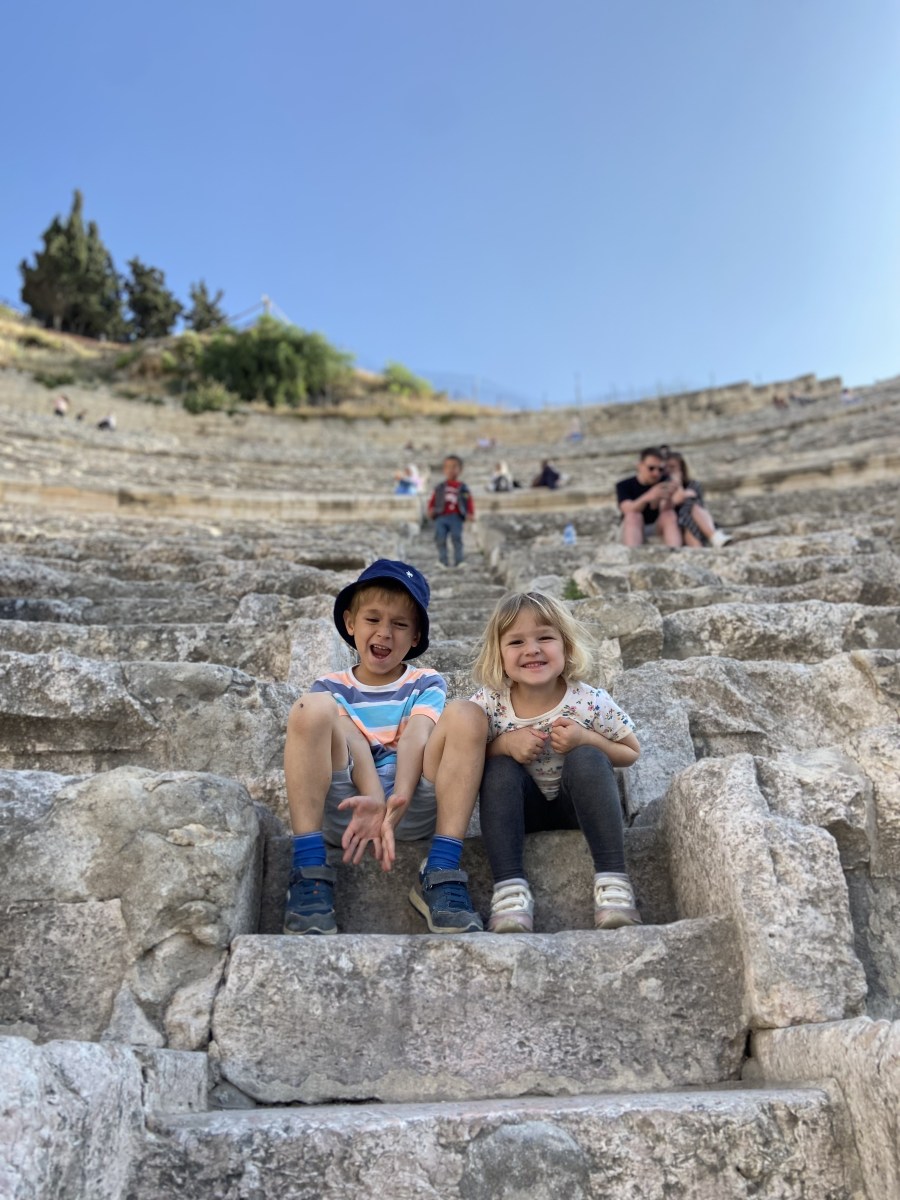
The Roman Theatre is one of Amman’s most recognisable landmarks.
Built during the Roman period, it is remarkably well preserved and sits right in the middle of modern Downtown Amman.
This was one of the places that really brought the city to life for us.
When we visited, there were plenty of local families around, and the open space around the theatre made it feel much less like a formal museum visit and much more like part of everyday Amman.
That makes a difference when you’re travelling with children.
Instead of saying, “Please stand quietly and admire this 2,000-year-old archaeological monument,” you can simply let them climb, explore and imagine what the theatre must have looked like when it was full.
Family tip: combine the Roman Theatre with Downtown and lunch rather than making a separate trip.
3. Wander through Downtown Amman
Downtown — or Al-Balad — is where Amman feels most alive. This is the place to wander rather than follow a checklist.
You’ll find shops, markets, bakeries, fruit stalls, spices, street food and plenty of people going about their everyday lives.
And this is where our food adventure really began.
4. Walk Rainbow Street
Rainbow Street is one of the best-known streets in Amman and a good place to experience the more contemporary side of the city.
There are cafés, restaurants, small shops and plenty of places to stop for a drink or snack.
We started our exploration here before making our way downhill towards Downtown.
Important family-travel lesson: downhill sounds easy. The problem is that eventually you have to go back up.
Amman is built on hills, so comfortable shoes are not optional.
5. Explore Jabal Al Weibdeh
If you have more than one day, make time for Jabal Al Weibdeh.
This neighbourhood has a very different atmosphere from Downtown, with cafés, galleries, independent shops and a strong arts scene.
It is a good place to slow down after visiting the major historical sights.
6. Visit the Jordan Museum
For families with older children, the Jordan Museum is worth considering, particularly if you’re travelling through the country and want some context for what you are about to see.
It can help turn the seemingly endless archaeological remains around Jordan into a coherent story.
If your children are younger, I would prioritise the Citadel and Roman Theatre first as there is more place to run around.
What to eat in Amman: Jordanian food you shouldn’t miss
One of the highlights of our time in Amman was, unsurprisingly, the food.
Jordanian food is one of those cuisines where sharing is practically part of the experience.
And travelling with children makes that particularly easy because you can order several things and let everyone try a little.
Here are the foods I would put firmly on your Amman list.
Falafel
Let’s start with the obvious one.
Falafel.
We had ours at Hashem Restaurant, one of Amman’s best-known traditional eateries.
And the verdict from our table?
Very good.
What struck us was how different the falafel tasted from the versions we are used to finding in Europe. It was fresh, green inside and much less dry.
Hashem is a famously informal place in Downtown, where the food rather than the décor is the star. It is also a useful introduction to Jordanian staples such as hummus and fuul.
For families, this is exactly the sort of meal that works: simple, inexpensive, shareable and recognisable enough not to frighten a cautious young eater.
Hummus
Yes, you have probably eaten hummus before.
But try it in Jordan anyway.
Fresh bread, hummus, falafel and a few other small dishes make an easy family lunch, and children can choose what they recognise while adventurous eaters work their way through the rest.
Kunefe / Kunafa
And then there was kunefe.
This was the sweet stop of our Amman day — warm, soft, sweet and absolutely worth making room for.
If your children have never tried it, this is likely to be a winner: crisp pastry, soft cheese and sweet syrup make for a dessert that feels rather more exciting than the average ice cream.
Our video includes our first taste, so you can watch the children’s verdict before deciding whether your family needs a kunefe stop.
Spoiler: yes, your family needs a kunefe stop.
Mansaf
You should also try mansaf, Jordan’s national dish.
Traditionally made with lamb, rice and jameed — a fermented dried yoghurt sauce — mansaf is an important part of Jordanian food culture.
It is considerably more substantial than falafel and hummus, so this is the dish to order when everyone has worked up a proper appetite.
Shawarma
A safe choice for children who are less adventurous with food.
Shawarma is widely available and makes an easy lunch or dinner when you need something familiar but still want to eat locally.
Fresh juice and mint drinks
Keep an eye out for fresh juices and traditional drinks as you wander around Downtown.
And if your children are anything like ours, the promise of a cold drink can be surprisingly effective at preventing a sightseeing mutiny.
Is Amman easy to visit with children?
Yes — with a couple of qualifications.
The biggest challenge is the the hectic vibes and the noise level. It took us a moment to get into the atmosphere of the city.
Then, Amman is steep and there are lots of stairs. A stroller can work in some areas, but it is not the city I would choose for a lightweight, easy-strolling holiday. For babies and toddlers, I would strongly consider a carrier.
We travelled with one and were very glad we had it.
Older children will generally enjoy the hills and stairs more than parents do.
The other consideration is traffic. Amman is a busy city, so when walking around Downtown, keep children close and allow extra time when crossing roads. Crossing the streets can be a challenge as well, as traffic lights are more a suggestion that actually respected.
Getting around Amman
For a short stay, you can combine walking with taxis or ride-hailing.
If you’re travelling around Jordan afterwards, however, a rental car can make a lot of sense.
We picked up a rental car directly at our accommodation, which saved us the trouble of going back to the airport.
From Amman we then drove towards Petra, and found the route straightforward and well signposted.
That said, driving in Jordan requires more concentration than driving at home. Road conditions and driving styles can differ, and official travel advice recommends extra care, particularly at night and on some highways.
For a family road trip, I would avoid driving after dark where possible.
Getting a SIM card in Amman
If you’re self-driving, having mobile data is extremely useful.
We stopped to buy a visitor SIM during our Amman sightseeing day and bought a 7-day data package for 6 Jordanian dinars.
That was enough for our immediate needs and gave us navigation and connectivity for the beginning of our road trip.
For families, I’d consider mobile data almost essential if you’re going to be driving independently.
Is Amman safe for families?
This is one of the questions parents understandably ask before booking Jordan.
The answer needs a little nuance.
Our own experience in Amman was very positive. We walked through Downtown, visited busy public places, ate in local restaurants and encountered plenty of families going about their everyday lives.
However, travel advice can change quickly, particularly because Jordan is in a region affected by wider geopolitical tensions.
As of August 2026, the UK’s FCDO advises against travel to certain parts of Jordan and highlights the possibility of regional escalation, protests and travel disruption. It also recommends remaining aware of your surroundings and following local authorities’ advice.
So rather than relying on a blog post — including this one — check your own government’s current travel advice immediately before travelling.
For the day-to-day experience in Amman, normal precautions apply: keep valuables secure, be aware in crowded areas, avoid demonstrations and follow local customs.
What should families wear in Amman?
Jordan is a predominantly Muslim country, so modest clothing is the respectful choice, particularly when visiting religious sites.
You don’t need to dress in traditional clothing, and foreign visitors are not generally expected to wear a head covering.
For families, lightweight trousers, longer skirts or dresses and tops covering the shoulders are sensible choices.
Bring something lightweight to cover your shoulders when visiting religious or more conservative places.
And don’t forget comfortable shoes.
When is the best time to visit Amman?
For sightseeing, spring and autumn are generally the most comfortable seasons.
March to May and September to November offer pleasant conditions for exploring Jordan’s archaeological sites and cities. We wnt in May and it was perfect for exploring outside, which is where you will spend most of your time.
Summer can be extremely hot, particularly when combining Amman with Petra and Wadi Rum.
Winter is cooler and can be wet, but it can also mean fewer visitors.
Is Jordan expensive?
Jordan isn’t necessarily a budget destination, particularly once you add major attractions, accommodation and transport.
But eating locally can be surprisingly reasonable.
Some of our favourite experiences in Amman were inexpensive meals rather than expensive restaurants.
The best strategy for families is to mix:
- Simple local restaurants
- Street food
- A few nicer meals
- Apartment-style accommodation where practical
- A rental car if you’re continuing around the country
The local currency is the Jordanian dinar (JOD). Cards are accepted in many hotels, restaurants and larger shops, but cash remains useful, particularly in markets and smaller businesses.
Do you need the Jordan Pass?
If Amman is part of a wider Jordan itinerary, check out the Jordan Pass before you travel.
The official Jordan Pass currently includes entry to more than 40 attractions, including Petra, Jerash and Wadi Rum, and can waive the tourist visa fee if you meet the minimum-stay conditions.
The current packages are:
- Jordan Wanderer: 1 day in Petra — 70 JOD
- Jordan Explorer: 2 consecutive days in Petra — 75 JOD
- Jordan Expert: 3 consecutive days in Petra — 80 JOD
There is an especially useful family detail: children under 12 can enter the included attractions free when accompanied by their parents, according to the current Jordan Pass terms.
Do the maths based on your actual itinerary rather than automatically buying one.
Our suggested 2-day Amman itinerary with kids
If you have two days, here’s how I would structure it.
Day 1 — Old Amman
Morning
- Amman Citadel
- Explore the viewpoints
- Walk/drive down towards Downtown
Lunch
- Local falafel and hummus
- Try Hashem or another busy local restaurant
Afternoon
- Roman Theatre
- Explore Downtown markets
- Kunefe stop
Evening
- Return to your accommodation
- Relax and enjoy the view over the city
Day 2 — Modern Amman
Morning
- Rainbow Street
- Jabal Amman
- Cafés and small shops
Lunch
- Traditional Jordanian food
Afternoon
- Jabal Al Weibdeh
- Jordan Museum or an art/cultural experience
Then get ready for the next stage of your Jordan adventure.
For us, that meant getting in the car and heading south towards Petra.
Amman with kids: our practical tips
1. Don’t try to see everything.
Amman is much more enjoyable when you leave some room for wandering.
2. Wear proper shoes.
The hills are real. Your children may find them entertaining. Your calves may disagree.
3. Bring a carrier for toddlers.
It was invaluable for us.
4. Eat locally.
Falafel, hummus and kunefe are easy family wins.
5. Carry some cash.
Cards are widely accepted, but smaller shops and market stalls may prefer cash.
6. Get mobile data.
Particularly useful if you are driving beyond Amman.
7. Start sightseeing early.
You’ll avoid some of the heat and have more energy for exploring.
8. Build in snack stops.
This is less a travel tip and more a parenting survival strategy.
9. Respect local customs.
Dress modestly and be particularly mindful around religious sites.
10. Check travel advice before you go.
The regional situation can change, so current official advice should always take priority over information published in a travel blog.
Frequently asked questions about Amman, Jordan
Is Amman worth visiting?
Yes. Amman combines ancient history, lively markets, excellent food and modern neighbourhoods, making it a worthwhile destination rather than simply an airport stop.
How long should I spend in Amman?
One full day covers the main highlights. Two days gives you enough time to explore at a more relaxed family pace.
Is Amman good for families?
Yes. The major attractions are interesting for children, local food is generally easy to share and Amman has plenty of open-air experiences. The main challenge is the city’s steep hills.
What are the best things to do in Amman?
The Citadel, Roman Theatre, Downtown Amman, Rainbow Street, Jabal Al Weibdeh and the Jordan Museum are among the best places to start.
What food should I try in Amman?
Start with falafel, hummus, fuul, shawarma and kunefe. If you have more time, try mansaf and other traditional Jordanian dishes.
Is Amman expensive?
It can be, depending on accommodation and activities, but local food and casual restaurants can be very affordable compared with many European destinations.
Can you walk around Amman?
Yes, particularly around individual neighbourhoods and Downtown. But Amman is extremely hilly, so don’t underestimate the distances or the stairs.
Do I need a car in Amman?
Not necessarily for the city itself. If Amman is the starting point for a Jordan road trip, however, renting a car can be convenient.
Can you use a stroller in Amman?
You can, but a carrier is often more practical because of the hills, stairs and uneven surfaces.
Is English spoken in Amman?
English is widely spoken, particularly in tourist areas and cities. Arabic is the official language.
What is the best time to visit Amman?
Spring and autumn generally offer the most comfortable sightseeing conditions. March–May and September–November are particularly good choices for a family trip.
Is Amman safe to visit?
Our personal experience was positive, but safety advice for Jordan is currently affected by wider regional developments. Check your government’s latest travel advice before booking and again immediately before departure.
Final thoughts: should Amman be on your Jordan itinerary?
Yes — and don’t rush through it.
Petra may be the headline act. Wadi Rum may provide the dramatic desert scenery. The Dead Sea may get the floating photographs.
But Amman gave us something different.
It is where we started to understand Jordan through everyday life: the bustle of Downtown, children playing around the Roman Theatre, the smell of freshly cooked falafel, the views from the hills and the wonderfully uncomplicated pleasure of eating something delicious straight from a local kitchen.
For us, two nights was the perfect introduction.
We arrived curious, ate very well, explored the city on foot, stocked up on mobile data and then picked up our rental car for the next chapter of the adventure: Petra.
And if you’d like to see what Amman actually looked like for us — including our accommodation, walk through the city, Roman Theatre, kunefe, Hashem Restaurant and our very enthusiastic food tasting — watch the full video here:
Watch our Amman, Jordan family travel video on YouTube
Next stop: Petra and Wadi Rum.
Safe travels!


