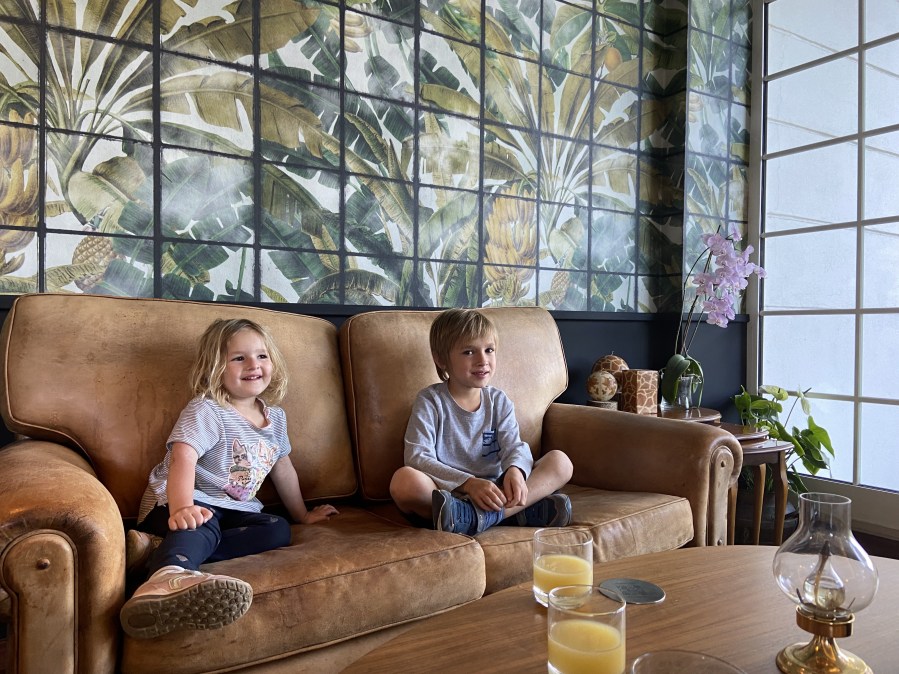
There is a moment on most family trips where someone — usually the smallest person at the table — says something that stops you completely. In Madeira, that moment happened over a plate of espada com banana at a rooftop table with the Atlantic spread out below us, when our seven-year-old announced that fish with banana was, and he was very clear about this, a completely mad idea that had somehow worked out. He has eaten in over thirty-five countries. He knows things. We took him seriously.
We have already written about what it is like to travel to Madeira with kids — the levadas, the cable cars, the slightly terrifying mountain roads that somehow feel worth it when you reach the top. But the food deserves its own post. Because Madeira surprised us on that front in a way we genuinely did not expect.
Portugal’s mainland is well established on the European food scene. But Madeira has its own culinary identity — shaped by its Atlantic position, its volcanic soil, its fishing traditions, and centuries of being a stopover island for ships crossing between continents. What arrives on the plate is something entirely distinct from Lisbon or Porto. And most of it, rather conveniently, turned out to be exactly the kind of food that works well for children — even seven-year-olds with strong opinions about fruit appearing in unexpected places.
First, the video
Before we get into the specifics — here is a short video from our time eating our way around the island. Fair warning: it will make you hungry.
[YouTube — https://youtu.be/OSpPW9Gzvzw]
The meal that made the trip — Casal da Penha
We need to start here, because this was the meal. Casal da Penha is a restaurant in Funchal with a rooftop terrace that sits above the old town and looks directly out over the city and the bay below. We arrived in the early evening when the light was doing exactly what it does in Madeira in summer — warm and golden and slightly unreal — and we sat down not entirely sure what we were about to eat and came away two hours later significantly happier than when we had arrived.
We ordered bolo do caco to start. Madeira’s flat round sweet potato bread, cooked on a basalt stone and served warm with garlic butter, is the kind of thing that should be available at all times in all places. Our son ate most of it before anything else arrived and showed no remorse whatsoever. We ordered more.
The squid was exactly what good squid should be — tender, not chewy, with enough char from the grill to taste like something rather than nothing. We have eaten squid in perhaps 20 countries between us and bad squid is one of the genuine disappointments of travel. This was not bad squid. This was the kind of squid that makes you think about ordering it again before you have finished eating it the first time.
Then came the espada com banana. And this is where things got interesting.
Espada com banana — the dish that requires a small explanation
We know. We know how it sounds. Fish with banana is not an obvious combination. When we described it to our son before it arrived he looked at us with the particular expression of a seven-year-old who suspects the adults have made a terrible mistake.
Espada is black scabbardfish — a deep-water species found in the waters around Madeira, with soft white flesh and a mild flavour. It is caught at significant depth and it is one of those ingredients that simply does not exist elsewhere in the same form. Served with a fried banana and passion fruit sauce, it is the dish that people who visit Madeira mention first when you ask them what they ate.
The banana is not sweet in the way a dessert banana is sweet. It caramelises slightly in the pan and takes on a richness that complements the delicate fish rather than overwhelming it. The passion fruit cuts through both. It is one of those combinations — like the first time someone put anchovies on pizza or chilli in chocolate — that turns out to be completely correct.
The foods you have to try
Bolo do caco
Already mentioned above but worth its own entry because it appears everywhere and is wonderful every time. Flat, round, warm, garlicky. You will find it at street stalls, in markets, and at most restaurants as a starter or side. At the Mercado dos Lavradores in Funchal, women sell them warm from a griddle beside stalls piled with passion fruit, custard apples, and jackfruit the size of small children. Go in the morning before the tour groups arrive.
Lapas — grilled limpets
This is the test. Every family has a food threshold — the dish that separates the adventurous eaters from the ones who will eat only bread for the rest of the holiday. In Madeira, lapas are that dish.
Tiny limpets grilled in their shells with garlic and butter and a squeeze of lemon, served sizzling on a hot plate. They look unusual. They smell magnificent. The best ones we had were at a small restaurant on the seafront in Câmara de Lobos — a fishing village about fifteen minutes west of Funchal that Hemingway apparently loved, though the main draw for us was the view and the extraordinarily fresh seafood.
Espetada
If you are travelling to Madeira with children who eat meat, espetada is the meal of the trip. Enormous skewers of beef marinated in garlic and bay leaf, cooked over wood fire and served hanging from a hook above the table on a rotating metal frame. It is theatrical. It is dramatic. It is exactly the kind of food presentation that makes children who were previously claiming not to be hungry suddenly very interested in dinner.
The traditional place to eat espetada is up in the mountains — around Monte or the Serra de Água area — where the restaurants are simple, the views are spectacular, and the portions are sized for people who have been doing serious physical activity, which we had not, but we made our best effort.
Madeira wine
For the adults — and this genuinely deserves more than a footnote. Madeira wine is one of the world’s great fortified wines and on the island itself it is served with a pride and specificity that makes the experience entirely different from ordering it at a restaurant at home. The range from dry to sweet, from Sercial to Malmsey, covers more ground than most people expect. We tried our first proper tasting on this trip — more on that in the video above — and came away with a significantly better understanding of why people have been sailing to collect it for centuries.
It is not, for the avoidance of doubt, something our seven-year-old was offered. He had passion fruit juice, which he rated extremely highly.
Poncha
Madeira’s traditional drink — aguardente, honey, lemon, and sometimes passion fruit — served in small ceramic cups at local bars in the old town. Strong, warming, and very good at the end of a long day on the levadas. Order it at a local bar rather than a tourist restaurant. Sit down. Let the evening arrange itself.
When adults want to do adult things — and children need something to do
Here is the part of family travel that nobody writes about quite enough: the moments when you are somewhere genuinely extraordinary — a winery, a long lunch, a serious tasting menu — and the children are present and enthusiastic and running entirely on their own agenda.
Madeira wine deserves time. A proper tasting — working through Sercial, Verdelho, Bual, Malmsey, understanding the solera system, asking questions, tasting again — is not a ten-minute exercise. It is exactly the kind of experience that rewards adult attention and that a seven-year-old with a full glass of passion fruit juice will have exhausted his patience for after approximately eight minutes.
When we visited one of Madeira’s wine estates, we discovered that the winery had thought about this problem more carefully than most. The children received activity books — printed pages with puzzles, drawing prompts, and questions about what they could see and smell around them — to work through while the adults tasted. You can see the moment in the video above: our son genuinely absorbed, pencil in hand, filling in pages at a tasting room table while we worked through a flight of aged Malmsey without anyone asking us when we were leaving.
It changed the dynamic of the whole visit. Instead of managing a restless child through an experience he could not participate in, we had a child who was engaged in his own parallel version of the same thing — observing, recording, making his own notes about the surroundings. He drew the barrels. He wrote down words he heard us use. He gave the winery a five-star rating on his own invented scoring system, largely on the strength of the passion fruit juice.
This is, we have come to understand after many years and many countries, the difference between a trip a child tolerates and a trip a child owns. It is not about making everything child-friendly in the generic sense — the softened edges, the dedicated menus, the supervised play area. It is about giving children the tools to be genuinely present in the places you bring them to, at whatever level of engagement is possible for their age.
An activity book at a winery tasting. A food log at a restaurant. A spotting challenge on a long drive. A drawing prompt on a ferry crossing. These are small things. But they are the things that show up in the journals years later as specific memories rather than a general blur of a holiday that happened once when they were seven.
If you travel regularly with children and find yourself looking for something more considered than a generic travel activity pad — something that actually follows the arc of a family trip from planning through to arrival and exploration — we have been quietly working on exactly that. The Family Explorer Collection is a suite of printable travel journals and activity books we designed for our own family and have now made available on Etsy. The Kids Explorer Activity Book has a food explorer section that would have served our son very well at that winery table. The Road Trip Activity Pack would have handled the drive from the airport. There is a planning system for the adults and sticker sheets for making every page feel like it belongs to the child who filled it in.
We are not suggesting you need a printable journal to have a good family holiday. Thirty-five countries and a pencil and a piece of hotel notepaper will do the job. But if you want something more structured — something the children will look back at and remember as theirs — it is there.
Where to eat with kids in Madeira — our actual recommendations
Casal da Penha, Funchal — the rooftop terrace alone is worth it. Go for the espada com banana, stay for the squid and the bolo do caco and the view. Book ahead for the rooftop in summer.
Funchal Mercado dos Lavradores — more experience than restaurant, but the stalls around the market sell bolo do caco and fresh fruit that make an excellent and very cheap lunch. Morning is best.
Câmara de Lobos seafront — for lapas and fresh fish. Any of the small harbour restaurants. The more basic the tablecloths, the better the seafood.
Any mountain restaurant with espetada — look for the hanging hook above the table. If they have a wood fire and a view, sit down immediately.
A practical note for families
Madeiran restaurants tend to open for dinner later than Northern European families are used to — kitchens are at their most welcoming from 7pm onward. Most places are genuinely child-friendly without making a performance of it: no dedicated children’s menus, but portions are generous, staff are accommodating, and no one has ever looked at our son with anything but warmth.
Bread arrives automatically at most restaurants. This is a very good thing when you have a hungry seven-year-old and a twenty-minute wait for lapas.
The honest verdict
Madeira surprised us as a food destination. We went for the nature — the levadas, the mountains, the dramatic coastline — and we stayed for the espada com banana and the Madeira wine and the squid on a rooftop above Funchal and a bolo do caco eaten warm from a paper bag at the market on a Tuesday morning.
That is the kind of eating that ends up in the journals alongside the cable cars and the flower market and the morning the clouds were below us on the mountain. Not just what we ate but where we were and who we were when we ate it.
Which is, when you think about it, exactly what food is supposed to do.
CGK
Have you been to Madeira? We would love to know what you ate — leave a note in the comments below. And if you are planning a family trip to the island, our full guide to travelling Madeira with kids is right here.


