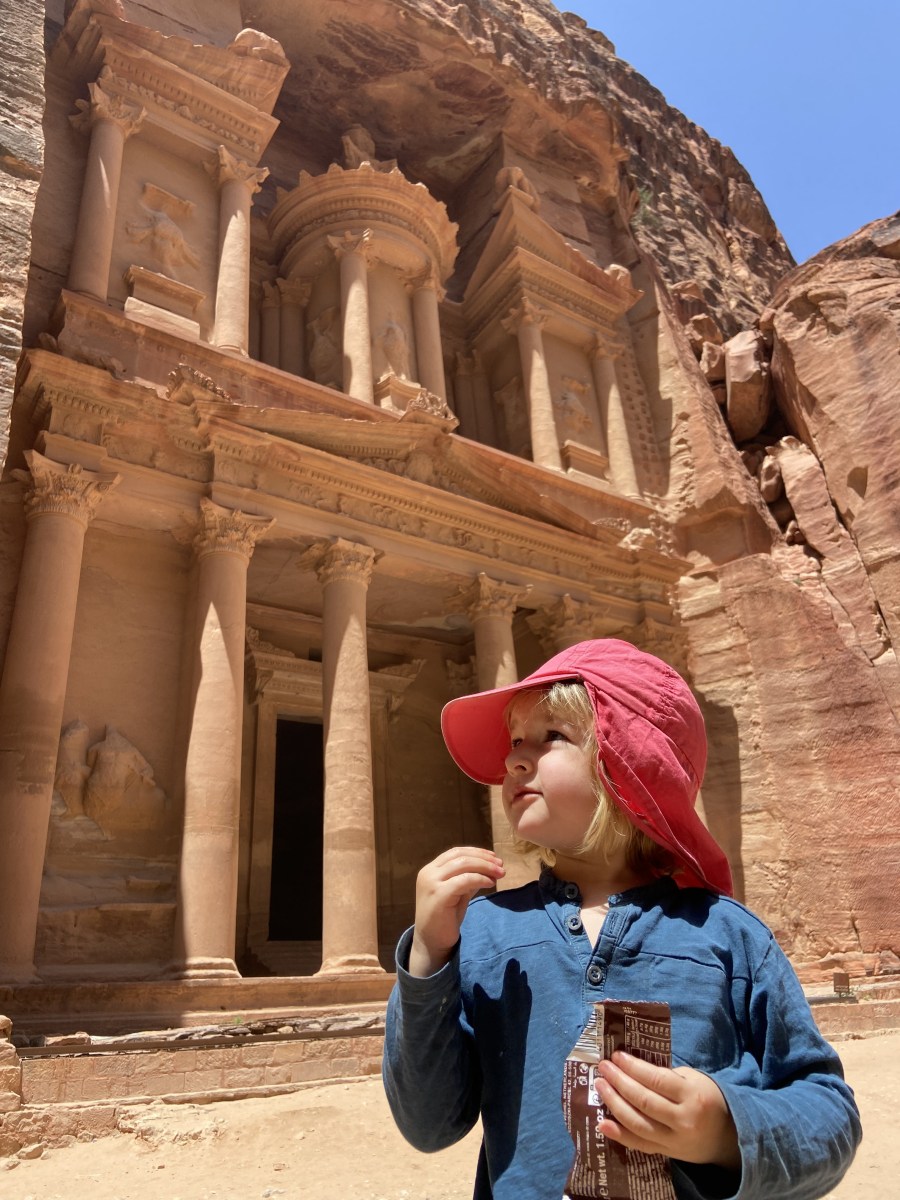
Planning Petra with kids? Our family guide covers walking, timing, tickets, Wadi Rum, transport and practical tips for planning your Jordan adventure.
Petra is one of those places that seems almost designed to make children feel as though they have accidentally walked into an adventure film.
You enter through a narrow canyon, follow the Siq, and suddenly the Treasury appears between the rocks. Then there are ancient tombs, enormous cliffs, carved façades, camels wandering around and, if everyone still has some energy left, a long staircase leading up to a monastery hidden high in the mountains.
And then, just when you’ve had enough ancient history for one day, you can head into the desert.
That was our plan.
We spent two nights in Wadi Musa, visited Petra with the children for a full day, and then drove south to Wadi Rum for a private one-day, one-night desert experience with Jordan Tracks.
It turned out to be a brilliant combination for a family trip — although Petra definitely requires a little more stamina than the photos might suggest.
Our Petra and Wadi Rum Experience
Before getting into the practical details, here’s the trip in a nutshell.
We drove from Amman to Wadi Musa and stayed two nights at Nomads Hotel, which was a convenient base for visiting Petra. We had a family room and found the hotel functional and well located, with the archaeological site just a short distance away.
On our arrival afternoon, we kept things easy. We explored the neighbourhood, stopped at a local restaurant where fresh bread was baked in front of us, and finished the evening on the hotel’s rooftop terrace overlooking the village.
The next morning, after breakfast, we drove to Petra’s main entrance.
We had booked an official guide for the day, which cost us 50 JD at the time of our visit. We then spent around six hours inside Petra, following the main route and exploring some of the site’s major sights.
The following morning we headed south towards Wadi Rum.
We had booked a private one-day, one-night “Bedouin Day” tour with Jordan Tracks. We left our rental car in Wadi Rum village and continued into the desert in their vehicle.
The day included dunes, canyons, Nabataean inscriptions, rock formations, viewpoints, tea, a desert picnic and sunset. We then spent the night at the Jordan Tracks camp in a simple family tent before returning to the village the following morning.
From there, we continued towards the Red Sea.
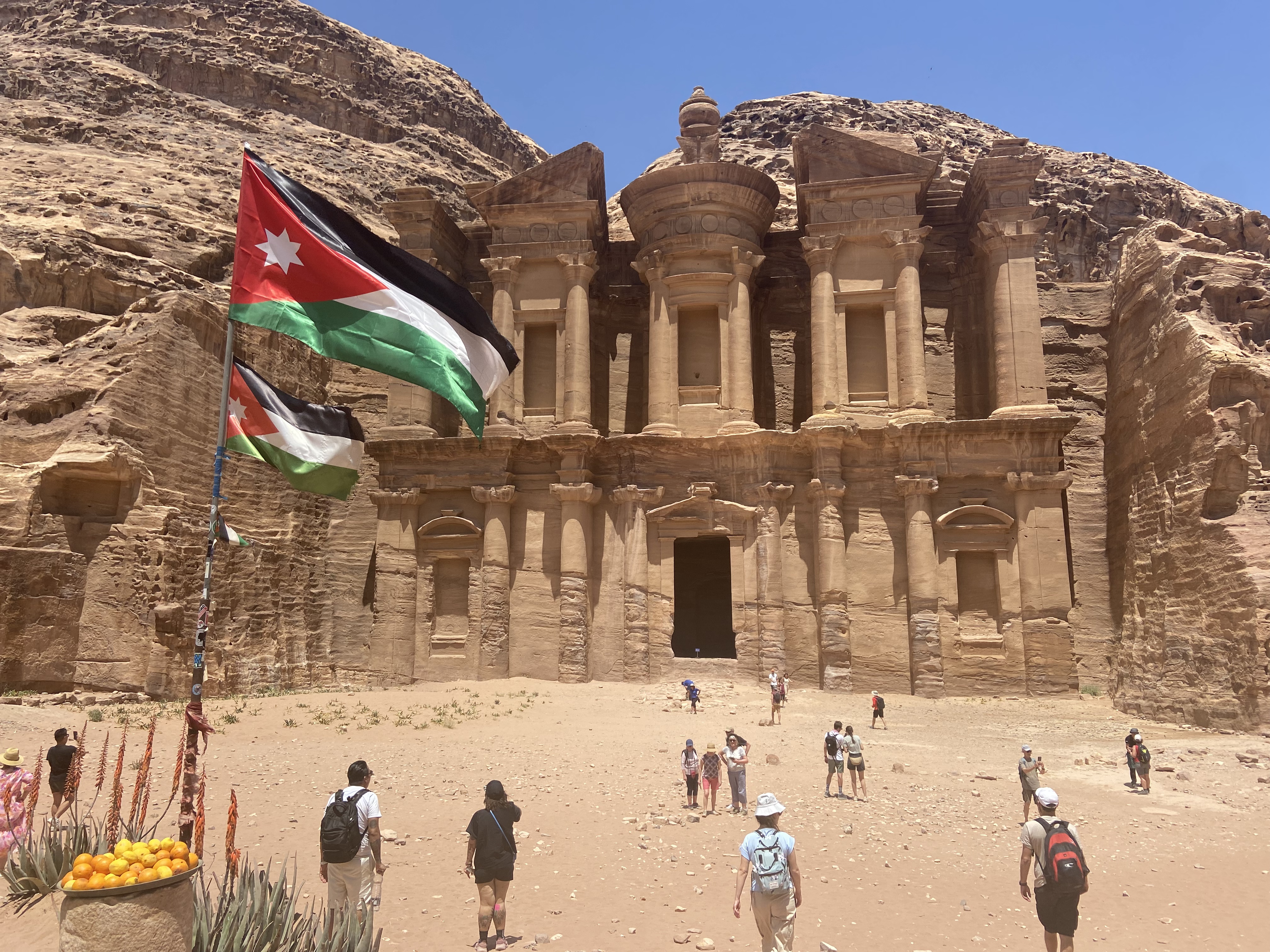
Petra with Kids: Is It Worth It?
Absolutely.
But I wouldn’t describe Petra as an easy family attraction.
It’s a big archaeological site, and visiting it involves considerably more walking than the iconic Treasury photograph might lead you to believe.
That’s actually part of what makes it so memorable.
Petra isn’t a single monument that you walk up to, take a photograph of and leave. The entrance leads through the Siq, and from there the archaeological site continues deep into the surrounding landscape.
We spent around six hours inside the complex and followed the main trail.
For our family, that was enough to get a real sense of Petra without trying to tick every possible viewpoint and hiking trail off the list.
And that is probably the first lesson I’d give parents:
Don’t plan Petra as though you’re visiting a museum. Plan it as a full day of walking and exploring outdoors.
The good news is that the walking is broken up by constantly changing scenery.
There is the Siq.
Then the Treasury.
Then the Theatre and the Colonnaded Street.
There are cafés and local artisans along the route.
There are tombs carved into the cliffs.
And, if you have the energy, there is the Monastery.
The children don’t have to spend six hours being interested in archaeology. They are essentially walking through an enormous adventure playground made of sandstone.
That helps.
How Long Do You Need in Petra?
You can visit Petra in one day, but whether one day is enough depends on what you want to see and how much walking your family is comfortable with.
We spent around six hours inside Petra and found that a full day worked well for us.
The official Petra site currently offers one-, two- and three-day tickets, reflecting the fact that the site can easily occupy more than one day for visitors who want to explore it extensively.
For families, I would think about it slightly differently.
One day in Petra
A full day is a good option if you want to see the main sights without turning the visit into a multi-day hiking expedition.
This is essentially what we did.
Two days in Petra
Two days make more sense if:
- your children are older and enjoy hiking
- you want to explore more of the trails
- you want a slower pace
- you want to include some of the more demanding viewpoints
- you don’t want to spend an entire day walking
With younger children
I wouldn’t arrive with a checklist of every possible Petra trail.
The Treasury alone is likely to be the moment everyone remembers.
Add the Siq, some of the main monuments, plenty of stops and time for snacks, and you already have a very worthwhile day.
Walking in Petra With Kids: What Should You Expect?
This is probably the most important practical question for parents.
There is a lot of walking.
The main route is not a flat paved attraction, and Petra’s scale means that even reaching the main sights involves a significant amount of time on your feet.
We walked for around six hours during our visit.
There were also plenty of opportunities to stop.
The children took a well-earned break at a café towards the end of the Colonnaded Street while I continued towards the Monastery.
And this is where our family experience is useful: you don’t have to do everything together.
If one parent and the older children want to continue while younger children need a break, splitting up temporarily can make the day much more manageable.
Just make sure everyone knows where and when you are meeting again.
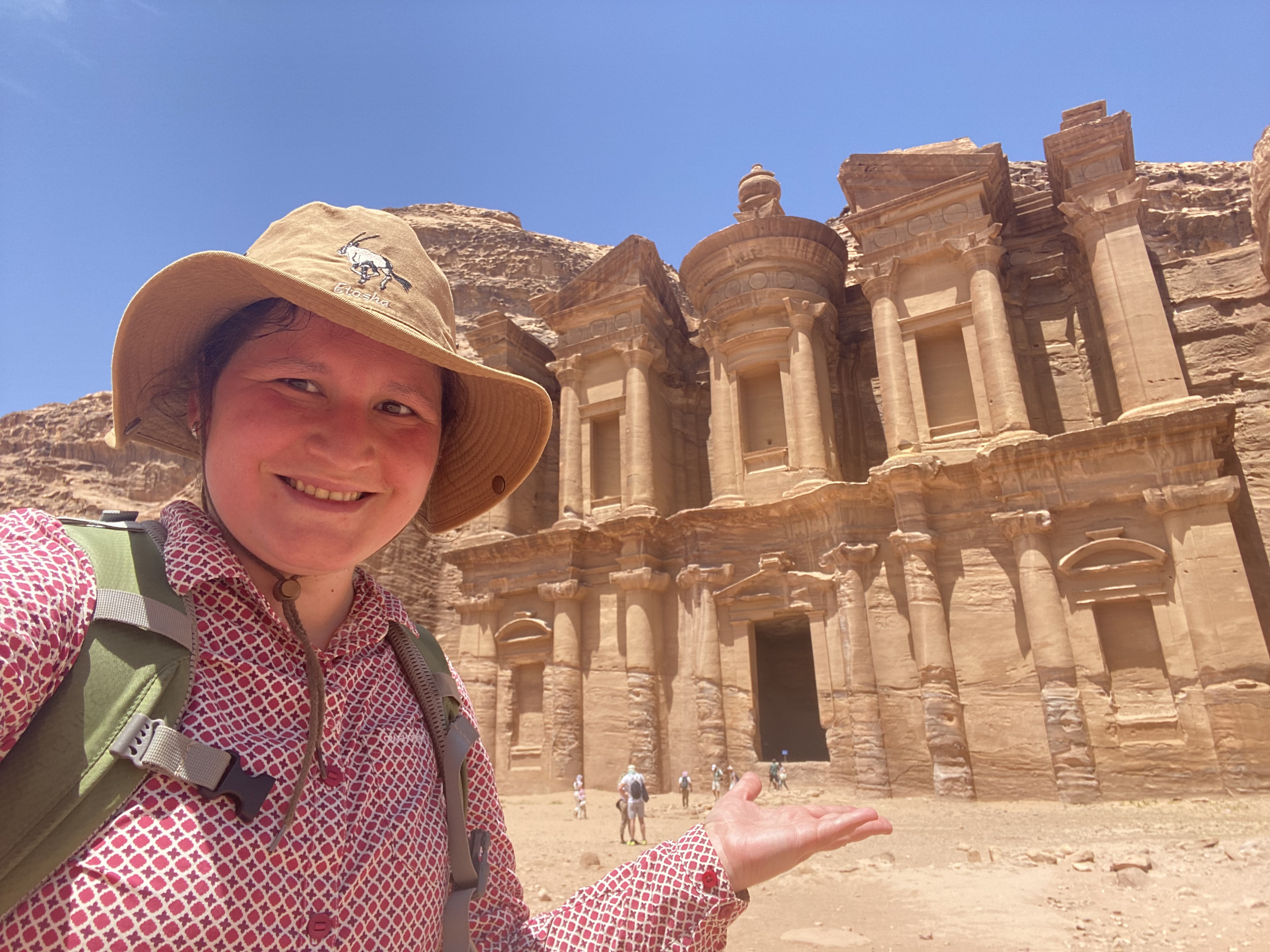
Can You Visit the Monastery With Kids?
This is where Petra gets considerably more demanding.
The Monastery is reached via a long staircase climbing up through the mountains.
I went ahead while the children and my husband stayed behind at the restaurant because it was getting hot and it was close to midday.
The climb took me a little over an hour.
And yes, there are a lot of steps.
Very roughly, the choice is:
Walk: around an hour or more depending on pace and stops.
Donkey: considerably faster, but whether you want to use one is a personal decision.
I would not tell every family that they “should” hike to the Monastery.
I’d say this instead:
Treat the Monastery as an optional extra rather than something that every family has to accomplish.
If your children are enthusiastic hikers, the climb can be one of the highlights.
If they’re hot, tired and have reached the point where another staircase is viewed as a personal insult, Petra is still Petra without it.
There is another way to enter the site, from the Monastery and then walk back towards the Treasury and then out though the main entrance.
But that will mean that you will see the Siq at the end, when leaving the site rather than building your anticipation at the very beginning. That will make the Treasury a bit more feasible for a family.
What We Loved Most About Petra
Interestingly, the Treasury wasn’t necessarily my favourite part.
For me, it was the Siq.
Walking through the narrow canyon, with the rock walls towering above you, creates anticipation before you even see the famous façade.
Then suddenly the Treasury appears.
It’s one of those travel moments that works equally well in real life as it does in photographs — which isn’t always the case.
The children also enjoyed the sense of adventure.
Petra doesn’t feel like a conventional historical site.
There are horses and camels, local artisans, cafés, rocky paths and enormous sandstone cliffs everywhere.
History is happening around you rather than being presented behind glass.
That makes a big difference when you’re travelling with children.
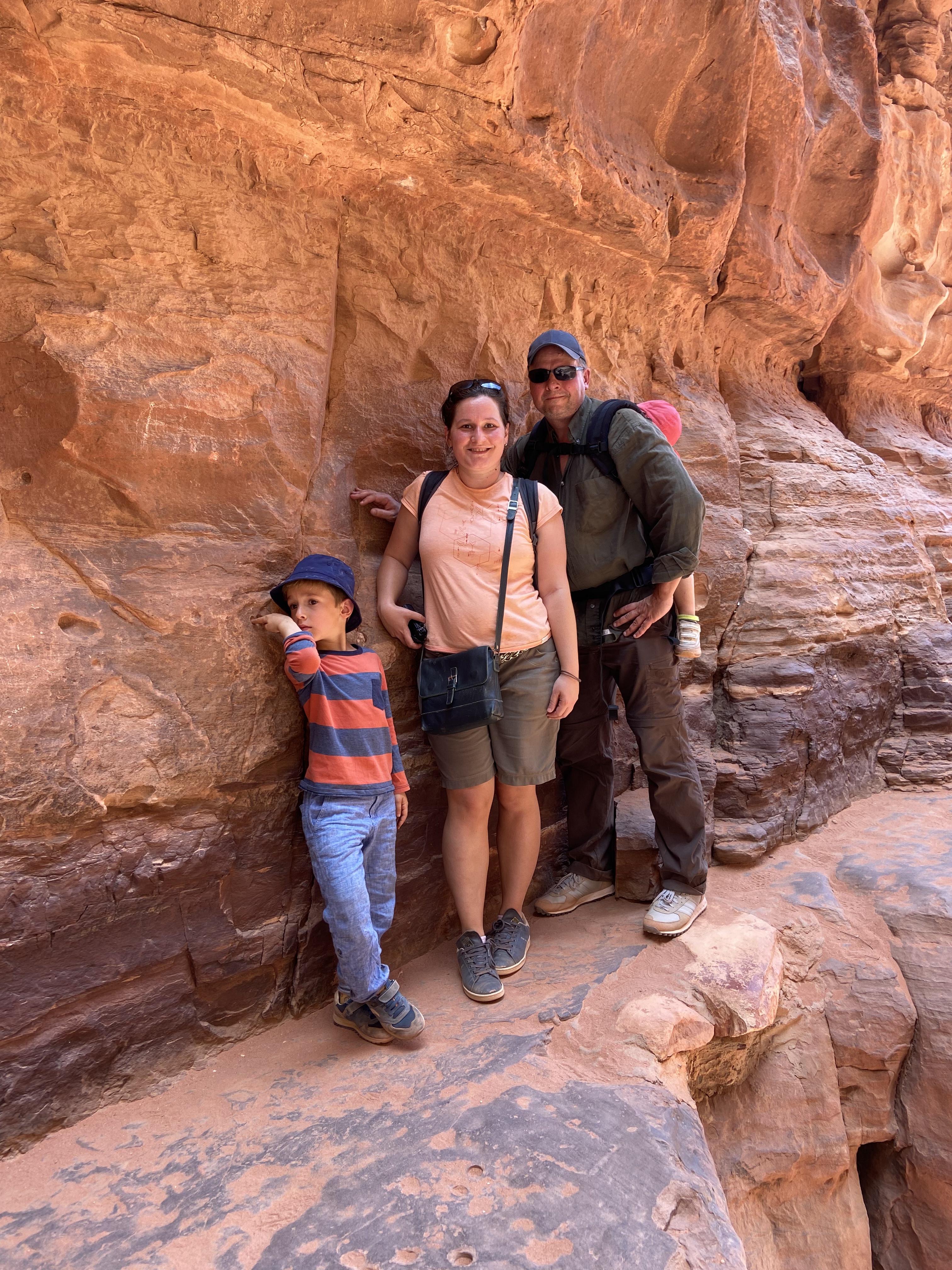
Petra Practical Tips for Families
Start Early
We had breakfast at the hotel before heading to Petra.
Starting early is particularly useful for families because the combination of walking and heat becomes increasingly challenging as the day progresses. We visited in May and it was already very hot.
Our own experience demonstrated that quite clearly: by around midday, the Monastery climb was no longer something that made sense for everyone.
Bring Water
This sounds obvious, but with children it becomes essential.
You’re outside for hours and the walking adds up.
Bring enough water and make use of opportunities to stop and refill where available.
Wear Proper Shoes
This is not the day for fashionable-but-questionable footwear.
Comfortable walking shoes with decent grip are much more useful, particularly if you want to venture beyond the easiest sections.
Plan for Breaks
Don’t make the mistake of thinking that stopping means you’ve “failed” to see Petra efficiently.
The breaks are part of the day.
We stopped for coffee and food, the children rested, and everyone had the opportunity to recharge before continuing.
Don’t Try to See Everything
This may be the most useful tip of all.
Petra is enormous.
You are unlikely to see everything in one day, and you don’t need to.
With children especially, choose the parts that matter most to your family.
Is Petra Suitable for Younger Children?
Yes — but I’d distinguish between possible and comfortable.
Younger children can absolutely visit Petra.
The bigger question is how much walking they can comfortably manage.
If your children are still small enough to need a stroller, I’d think carefully about whether the terrain and distance make a stroller worthwhile. For a full Petra day, a carrier can be considerably more practical for very young children, while older children who can walk independently have much more flexibility. We used a hiking backpack and it was the absolute best decision.
The best approach is to build your visit around the family’s energy level.
Where We Stayed in Petra: Nomads Hotel
We spent two nights at Nomads Hotel in Wadi Musa.
Our family room was functional and perfectly adequate for our stay, and one of the main advantages for us was the location.
It is close to Petra, making it a practical base rather than somewhere that requires a major logistical operation every morning.
The hotel also has a rooftop terrace with views over the village, which turned out to be a lovely place to end the day.
After six hours of Petra, nobody in our family was particularly interested in an elaborate evening programme.
Dinner, a view and a relatively early night were much more appealing.
For families, that kind of convenience matters.
What to Do in Wadi Musa After Petra
We kept our first evening deliberately low-key.
We headed to a restaurant in the neighbourhood where fresh bread was baked in front of us.
The food was simple, fresh and full of flavour, and watching the bread being made was part of the fun.
It was also a useful reminder that family travel doesn’t have to mean finding a restaurant specifically marketed as “family friendly.”
Sometimes the best family meal is simply somewhere that serves good local food and doesn’t require everyone to sit through a two-hour tasting menu.
We finished the evening on the Nomads rooftop terrace.
It was a quiet end to what would be our only full day of Petra.
Wadi Rum With Kids: From Ancient City to Desert
The contrast couldn’t have been greater.
One morning you’re walking through one of the world’s great archaeological sites.
The next, you’re sitting in the back of a 4×4 surrounded by red sand and enormous sandstone formations.
We drove from Petra towards Wadi Rum and booked a private one-day, one-night Bedouin Day tour with Jordan Tracks.
The company currently describes its Bedouin Day as a one-day/one-night Wadi Rum experience covering the classic desert sights, including Lawrence’s House and Spring, Nabataean inscriptions, red sand dunes and the Um Fruth and Burdah rock bridges, with a night in a Bedouin camp.
That was very close to the experience we had.
What Is a Wadi Rum Jeep Tour Actually Like?
Our Wadi Rum day was less about ticking off attractions and more about experiencing the landscape.
We left our rental car in Wadi Rum village and continued with Jordan Tracks’ vehicle.
Our route took us through a series of desert landscapes and stops.
We visited Lawrence’s House and Spring, climbed a red sand dune for the views, looked for Nabataean inscriptions in the narrow canyons and stopped at different viewpoints and rock formations.
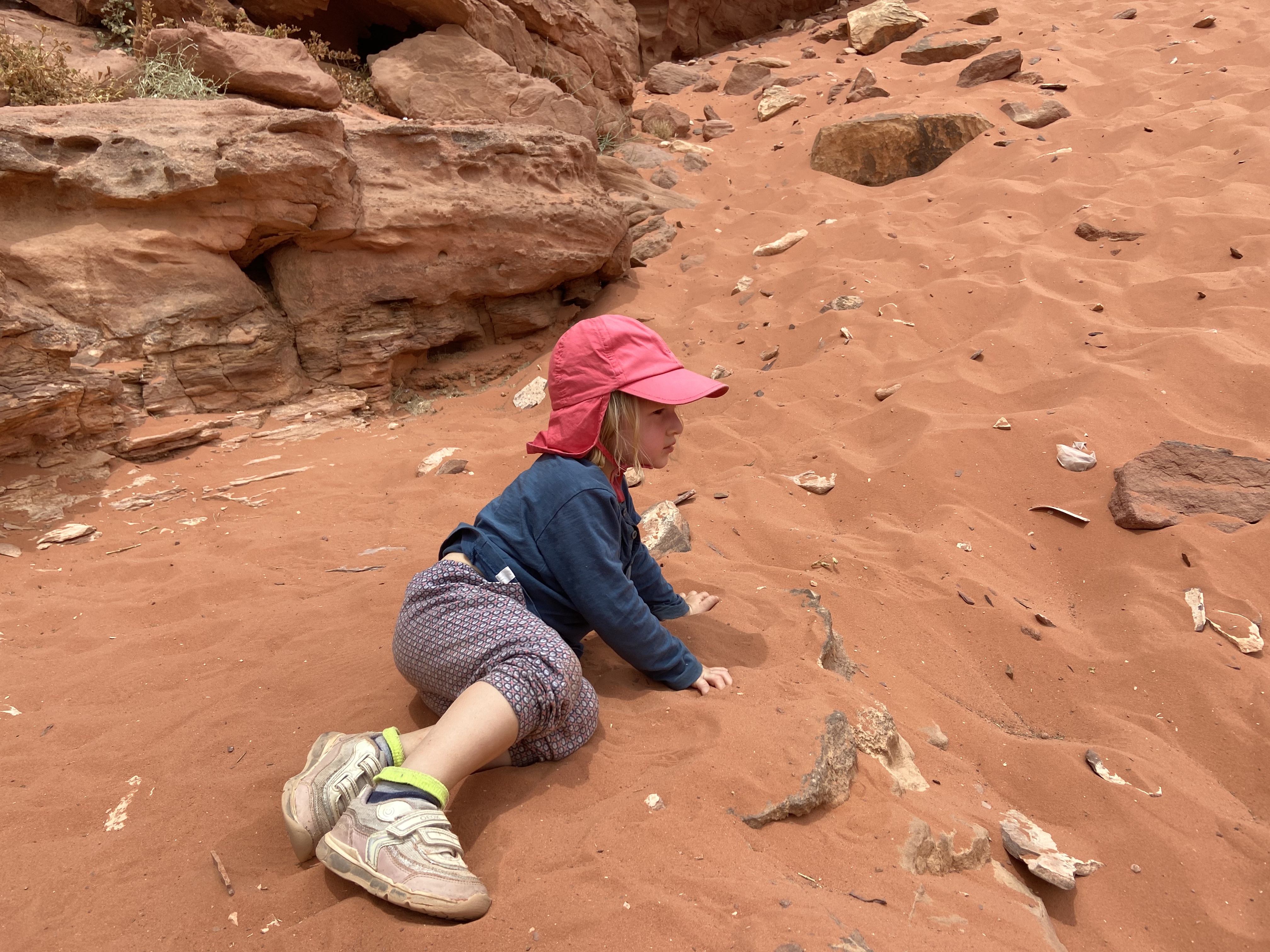
There was also time for a desert picnic, tea and, naturally, quite a bit of running around in the sand.
The children had plenty of opportunities to climb, explore and simply be children.
Is Wadi Rum Good for Kids?
For our family, absolutely.
And in some ways, Wadi Rum was easier with children than Petra.
There is walking, but you’re not walking continuously for six hours.
The 4×4 moves between locations, and the stops provide natural changes of pace.
The children can climb dunes, explore rock formations, walk through canyons and play in the sand.
There is also something wonderfully freeing about the desert.
There are no museum rules to remember.
No “don’t touch.”
No “stay behind the rope.”
The landscape itself becomes the activity.
That said, desert conditions matter.
Heat can be intense, and children need protection from the sun, plenty of water and sensible clothing.
The exact experience will also depend on the tour you choose and the time of year.
Spending the Night in Wadi Rum With Kids
For us, staying overnight was an important part of the experience.
You can visit Wadi Rum as a day trip, but the desert changes completely once the day-trippers leave.
We spent the night at the Jordan Tracks camp in a simple and clean family tent.
The camp is located inside the protected area, around 10 km from Wadi Rum village. These are private Bedouin tents with beds, bedding, electricity from solar panels and access to proper toilet and hot-shower facilities.
Our own family tent was simple rather than luxurious, but it was exactly what we needed.
And that’s worth emphasising.
You don’t need a luxury desert bubble to make Wadi Rum special.
You’re there because of what is outside the tent.
What Should You Pack for Wadi Rum With Kids?
Keep it practical.
For a desert day and night, we’d recommend:
- plenty of water
- sun protection
- sunglasses
- hats
- comfortable walking shoes
- light, breathable clothing
- a warmer layer for the evening
- a small daypack
- basic toiletries
- anything your children need for the night
And don’t underestimate the temperature change after sunset.
The desert can be extremely hot during the day and surprisingly cool at night, depending on the season.
Petra and Wadi Rum Itinerary: How We Combined Them
Our route was deliberately simple:
Day 1 — Amman → Petra
Drive from Amman to Wadi Musa.
Check in at Nomads Hotel.
Explore Wadi Musa and have dinner locally.
Day 2 — Full Day Petra
Breakfast.
Drive to Petra’s main entrance.
Spend approximately six hours exploring the site.
Take breaks along the way.
Return to Wadi Musa for dinner and rest.
Day 3 — Petra → Wadi Rum
Start early.
Drive to Wadi Rum.
Leave the rental car in Wadi Rum village.
Begin the Jordan Tracks desert tour.
Explore Wadi Rum throughout the day.
Watch the sunset.
Dinner and overnight in the desert camp.
Day 4 — Wadi Rum → Red Sea
Breakfast.
Return to Wadi Rum village.
Collect the rental car.
Continue towards the Red Sea.
For us, this worked particularly well because we didn’t try to squeeze Petra and Wadi Rum into the same day.
That is something I’d recommend to other families whenever the itinerary allows.
Petra deserves the time.
Wadi Rum deserves the time.
And your children probably deserve not to be transported from one major attraction to another at maximum speed.
Do You Need Two Days in Petra?
Not necessarily.
Our experience is a good example of why.
We stayed two nights in Wadi Musa but spent one full day inside Petra.
That gave us:
- an arrival afternoon
- a full Petra day
- a relaxed evening afterwards
- an early start towards Wadi Rum
For many families, this is a very sensible configuration.
If you’re serious hikers or want to explore more of Petra’s trails, add another day.
If your priority is experiencing the main site without exhausting everyone, one well-planned full day can work very well.
The important thing is not confusing “one day” with “a quick visit.”
We spent around six hours there.
That’s a full day by most children’s standards.
Jordan Pass: Is Petra and Wadi Rum Included?
This is one area where it’s particularly important to check the rules before travelling, because visa and attraction arrangements can change.
When we visited, we had bought the Jordan Pass, partly because we needed the visa arrangement and because Petra was included.
The current official Jordan Pass information confirms that the pass covers more than 40 attractions, including Petra and Wadi Rum. It also states that the pass is not itself a visa: rather, it can waive the visa fee for eligible travellers who stay in Jordan for at least two whole nights/three days and purchase the pass before arrival.
The current Jordan Pass FAQ also states that children under 12 do not need to purchase a separate pass and can enter tourist sites free when accompanied by their parents.
So if you’re travelling as a family, this is definitely something to investigate before buying individual attraction tickets.
Important: always check the current official Jordan Pass conditions for your nationality and travel circumstances before relying on the visa waiver.
What Does Petra Cost?
For reference, Petra’s current official ticket information lists:
- 1 day: 50 JD
- 2 days: 55 JD
- 3 days: 60 JD
The official site also currently lists the main trail guide at 50 JD, with higher prices for guides covering additional routes. Children under 12 receive complimentary admission during daylight visiting hours.
These are the current published prices, not necessarily the prices we paid on our trip.
If you’re planning your budget, check the official Petra and Jordan Pass websites shortly before travelling.
When Is the Best Time to Visit Petra and Wadi Rum With Kids?
For families, I’d prioritise comfortable temperatures over squeezing the trip into the busiest summer period.
Both Petra and Wadi Rum involve substantial time outdoors, and Petra in particular is much easier to enjoy when you’re not battling extreme heat.
Spring and autumn are generally the most comfortable periods for walking and desert activities.
If you travel outside those periods, adapt your itinerary accordingly:
- start Petra early
- carry plenty of water
- schedule breaks
- avoid the hottest part of the day for demanding climbs
- don’t underestimate the desert sun
Our own Petra experience made this particularly obvious.
By the time we reached the Monastery climb around midday, the heat was enough that the children sensibly opted out.
That wasn’t a failure of the itinerary.
It was good family travel.
Petra or Wadi Rum: Which Will Kids Like More?
This is almost impossible to predict.
And that’s precisely why I wouldn’t choose between them.
They offer completely different experiences.
Petra
Best for children who enjoy:
- exploring
- history
- ancient ruins
- walking
- climbing
- discovering things around corners
Wadi Rum
Best for children who enjoy:
- adventure
- deserts
- 4×4 rides
- climbing dunes
- running around
- rocks and canyons
- sleeping somewhere unusual
For us, the combination worked because the experiences complemented each other.
Petra gave us the history and sense of discovery.
Wadi Rum gave us space and adventure.
What Would We Do Differently?
The biggest thing I’d change isn’t actually the itinerary.
It’s the expectations.
I would go into Petra knowing that you won’t see everything.
And I’d plan the day around the family rather than around the map.
If the children are tired, stop.
If it’s getting too hot, stop.
If one child wants to explore while another wants to sit with a drink, that’s fine.
You are not taking an exam at the end of Petra.
You don’t get extra points for reaching every viewpoint.
The same applies to Wadi Rum.
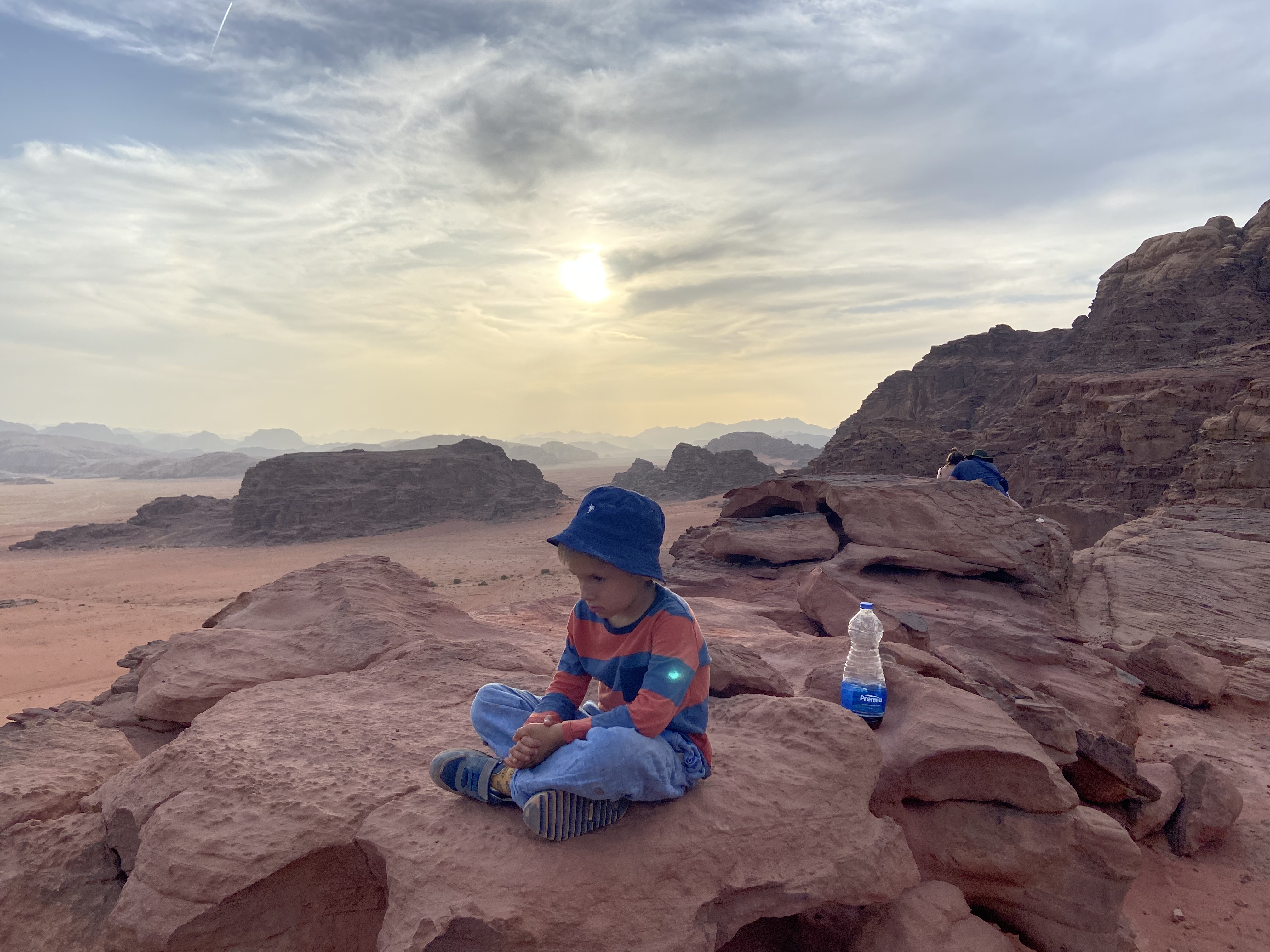
The beauty of the desert is that you don’t need to fill every minute with an activity.
Sometimes climbing a dune, throwing sand at your sibling and drinking tea while looking at the landscape is the activity.
So, Is Petra and Wadi Rum Worth It With Kids?
For us, definitely.
Petra was one of the more physically demanding family experiences of our Jordan trip, but it was also one of the most memorable.
The children didn’t need to understand every detail of Nabataean history to enjoy it.
They could explore the Siq, discover the Treasury, watch the camels, climb around the rocks and feel as though they were part of an adventure.
Wadi Rum provided a completely different kind of experience.
There was less walking, more movement, plenty of space to explore and the novelty of sleeping in the desert.
And that is ultimately why I’d recommend doing both.
Petra and Wadi Rum aren’t two versions of the same Jordan experience. They’re almost opposites.
One takes you into a city carved from stone.
The other takes you into a landscape where the horizon seems to go on forever.
For families building their own Jordan itinerary, that combination is hard to beat.
Just remember the two golden rules:
Give Petra enough time.
And don’t underestimate the desert sun.
If you’d like to see what our family experience actually looked like rather than just reading about it, watch the video below — especially if you’re trying to decide whether Petra and Wadi Rum would work for your own children.
Watch the full Petra & Wadi Rum family travel video here:
https://youtu.be/XY2RElY44Cc
Useful Official Planning Resources
Before travelling, check the latest information directly with the relevant authorities/operators:
- Jordan Pass — current attraction, visa-waiver and child-entry conditions. Jordan Pass official website
- Petra Development and Tourism Region Authority — current entrance fees, guides and visitor information. Visit Petra official website
- Jordan Tracks — current Wadi Rum tours and camp information. Jordan Tracks
Prices, opening arrangements and tour conditions can change, so verify them shortly before your trip.
Safe travels!


