We flew via London and landed in Muscat on Saturday early morning after a 8 h overnight flight . If you do go via London Heathrow International Airport , there is a pretty cool play area for toddlers and pre- schoolers at gate A3 in Terminal 5. Check it out if you have more than a couple of hours to spare. Otherwise, keep in mind that Heathrow is huge and even transfer within the same terminal might take almost one hour.
The first day in Muscat was for getting accustomed with our new surroundings and exploring a bit the neighbourhood. We grabbed a cab from the airport from Airport Taxis (red and white cars). They are al metered. A trip to Al Qurm was 16 OMR and took 20 min. Our hotel was Crown Plaza Muscat, a seaside building with newly refurbished areas like the outside swimming pool.
From our hotel we could access the neighbourhood of Havy as Saruj via a coastal and beach walk. It takes about 45 min to get to the area around Intercontinental Hotel, a popular area where locals and tourists get together, especially at week-ends. The main access street is 2817 Way, very close to the ’embassy quarter’: an area filled with beautiful and well preserved traditional houses. Also, we made a photo stop at the Muscat Opera House, about 10 min walk inland. For dinner, there are a number of restaurants at the end of 2817 Way. We tried and liked D’Arcy’s Kitchen. They have a kid menu full of the old international favourites for fussy eaters and a few local dishes. The terrace is lovely for some people watching and relaxing after a night of travel. For a more traditional experience (lovely camel dishes) head to Ubhar restaurant, on the main road, 100 m or so from the Opera House.
Day 2 MUSCAT
Day 2 started with our driver waiting for us for a full day tour of the capital. Muscat is extremely spread out and the sights do require some planning for doing (most) in one day. If you do not hire a driver, ask your hotel to help to organise a cab. That will shorten considerably transit times. As most hotels are a bit far out the old center, cab might be your only solution to get the most out of your stay. The Crown Plaza offered a free shuttle to the Grand Mosque, to the Grand Mall in the morning and to the Muttrah Souq in the afternoon.

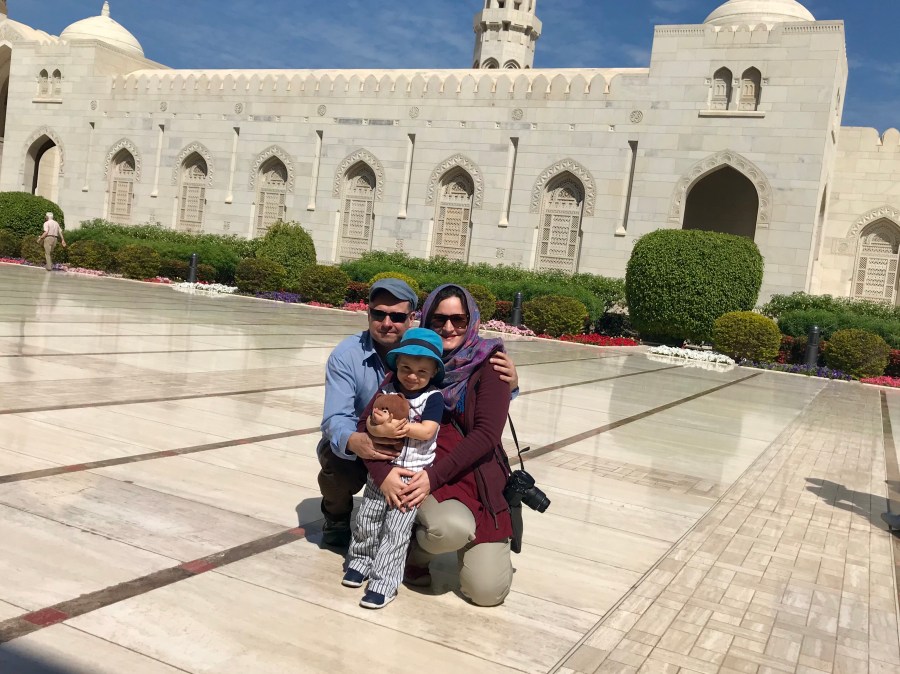
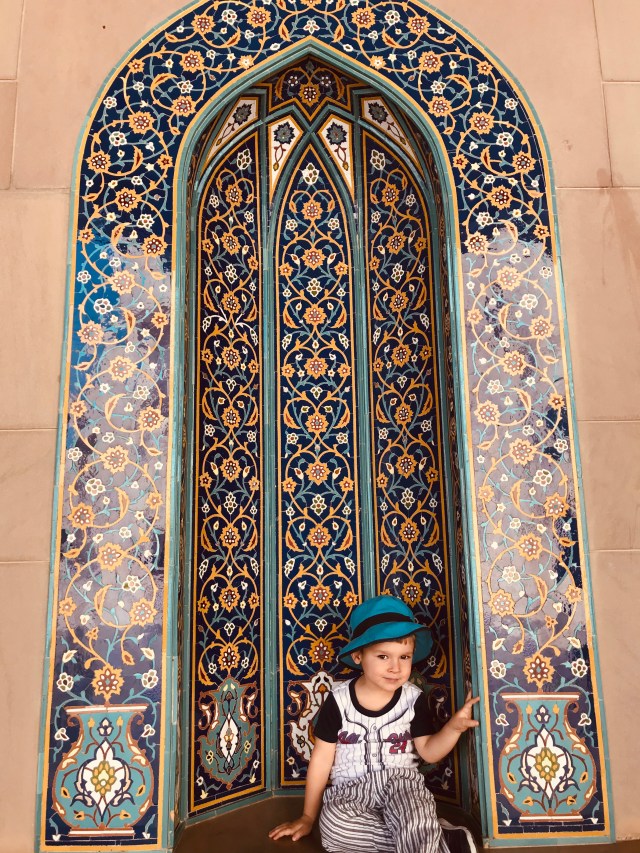
Start you sightseeing day at Sultan Qaboos Grand Mosque: the building has been inaugurated in 2001 to celebrate the 30th anniversary of Sultan Qaboos’ ascent to the throne; this mosque can accommodate over 20,000 worshipers and is a true masterpiece of modern architecture, harmoniously combining various artistic currents of the Islamic world from Maghreb to Central Asia. The mosque is only opened till lunchtime so it is best to make this the first stop. Women must be dressed with long skirts, sleeves and cover their head. There is only the main prayer hall that is not accessible to children below 10yo. We took turns to go inside while the other was taking Mr L to take beautiful photos of he gardens. The mosque complex is very big and you should allow 1h30 for the visit.
We continued to the historic district of Mutrah. This is the port part of the city and one of the most touristy. The main attractions here are the famous Souq and the corniche. Both are accessible with the stroller. After a whole morning of running around in the mosque gardens, Mr L was happy to just rest in the stroller and look at his books. What I found to be of a very accessible price in the market were local spiced and dates. In fact, most of the souvenirs we brought consisted of different sorts of spices, some of which can get very expensive in Europe (fenugreek).
About 200 m from the main Souk entrance there was a lovely Indian restaurant with a street terrace: Royal House. We had the fish of the day and rice dish with the ubiquitous lemon mint lemonade. The food was simple but really tasty. Even the LO had a few bites. We then tool a walk along the corniche and admired the royal boats moored in the harbour.
In the afternoon you could visit the National Museum: opened in 2016, the museum houses 12,500 artifacts that show the historical, archaeological and cultural richness of the country. Start by watching the short movie that will provide the context for most of the exhibits. While the museum doesn’t speciafically cater for kids, we found some rooms to be quite etertaining for the young audience, especially the full size traditional boat and the horse vs camel as transport means. You also have a baby care room in the museum which might come in handy as most restaurants will not have changing tables. you should count at least one hour for the museum.

We finished the tour with a short walk and photo stop at the Sultan’s Palace (Al Alam Palace), the bright coloured building that you can see from the steps of the National Museum. The palace itself cannot be visited. Behind tha palace, there is another beautiful view point over Jalali and Mirani Portoguese Forts.
Day 3: Birkat Al Mawz – Jabreen – Bahla – Nizwa
After a lovely breakfast at the hotel, we headed to picturesque Birkat Al Mawz, a village famous for its lush palm grove and Falaj Al Khatmeen, a 17th century channel for irrigation listed as Unesco World Heritage Site. It is an easy drive from Muscat, about 1h30 min on a sealed road.
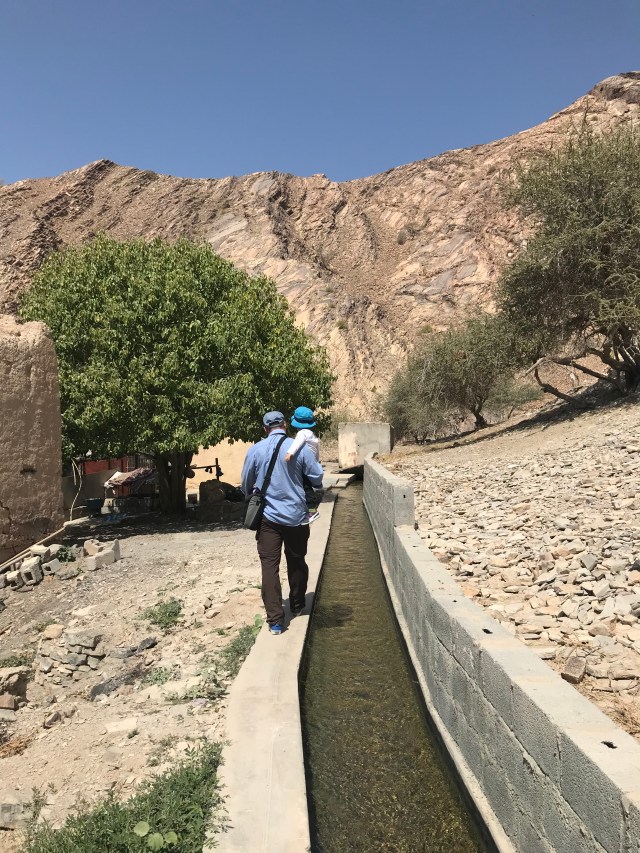
Here you can visit a small traditional house where the locals have gathered a few every-day use objects, like tools used to farm the land and photos of the families that used to live in the area. Just above this house-museum is the access to the old town and the irrigation channels. Most of the village is in ruin, so you have to be carefull at the seep steps. We accesed a few of the narrow alleys and could even enter some of the houses but the nicest part was just following the old irrigation channels. We were almost alone in this quaint village and took our time to look around and play in the irrigation channels.
The next stop was Jabreen Castle, that welcomes visitors with fine painted wood and stucco ceilings dating back to the 17th century. Oman has a number of forts ond castles but if you are to choose one, Jabreen seems to be the best compromise. It is quite big but not as huge as Bahla Fort. Also it has beautiful panoramic views from its roof and a variety of rooms that you can enter as well as balconies and terraces. The dates storage room was something particualar to Oman and it is intersting to take a guide or at least an audio guide (avavialbe at the entrace) to get more explanations on the role of dates syrup at the time. You will have to prepare for many, many steps. A carrier is essential for younger kids if you want to reach all the castle sections. You should count about 1h30 for the castle visit.
The final stop for the day was at Bahla Fort, another Unesco World Heritage Site, where you can admire a very imposing example of islamic architecture. The fort is quite huge and it has many smaller and darker rooms compared to Jabreen. And many flights of stairs. We were quite exhausted after the visit to Jabreen Castle and LO was pretty convinced that he did not want to climb any more steps so we had a short visit. If you want to visit both the castle and the fort, I would suggest to do it on different days or it might get a bit repetitive, esocailly for the young kids.
We spend the rest of the afternoon in Golden Tulip Nizwa, a large hotel with a nice pool and a small kid play area ( with a slide and a few swings). The beds are huge and comfortable but the bathrooms are a bit dated, as is the breakfast restaurant. It is solid choice in the area but we found the breakfast to be quite disappointing for a 4 star hotel. It is also a bit of a drive outside the city so be pepared to dine on site. They have great indian food though.
Day 4: Nizwa – Jebel Shams – Misfah
The morning was dedicated to visiting Nizwa, former capital during Yaroubi dynasty and still important cultural and religious center, known as the Pearl of Islam. Westarted with a visit of the Souq, and the Fort, with its massive guard tower offering beautiful views on the Friday Mosque and on date plantations. In the Souq you will find different buildings for crafts, livestock, vegatebles and dates. You can also sample the traditional desert: halva that is sold in plastic bowls in the dates souq.


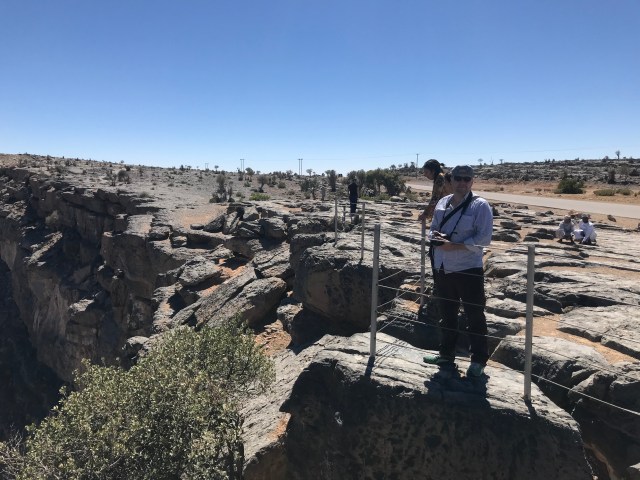
The next stop was the Grand Canyon, a stunning 1,000 meters deep gorge which lies at the foot of Jebel Shams, the highest peak of Oman. To reach the panoramic view of the canyon, follow the signes to Jebel Shams Resort. The sealed road climbs steadily after Ghul and soon the tarmac will end. After that, there is an off road uphill drive of at least 45 min. A 4×4 is essential to go up the mountain but the views from the end of the sealed road and until Jabal Shams resort are really impressive and worth the extra effort. You will be rewrded with grand views down into the great chasm of Wadi Nakhr (also sometimes referred to as Wadi Ghul, to which it’s joined), and popularly known as the “Grand Canyon” of Oman. The main road up the mountain finishes at the Jabal Shams Resort, from where a side track runs a couple of kilometres to the windswept hamlet of Khateem.
For older kids, you can attempt to do the full canion hike of about 3h called the Balcony Walk. Khateem is the starting point for this spectacular hike (clearly marked with the usual red, white and yellow stripes). This is probably the most famous hike in the country, winding around the cliffs halfway up the rim of Wadi Nakhr. We stopped for lunch at Jabal Shams Resort. Even if you are not residing at the resort you can have a simple but very tasty buffet lunch for 5 OMR per person.
After speding a bit more time admiring the canyon views, we continued driving down to to Misfah village, the highest point in Jebel Shams that you can reach without a 4×4 drive.
Perched on the steep mountain walls, here you can see old stone and the ancient system of cultivation on terraces. We took a lovely 1 h walk outside the village, following the yellow, red and white stripes signalling. It follows roughly the main irrigation channel and it takes you through cultivated terraces and and the rock. It is not a flat walk but still doable for the 3 year old even if the path would get narrow at times. After an hour of climbing the many steps in Misfah to discover the old city, it was a bit of a relief to have a more relaxed hike with such amazing views.
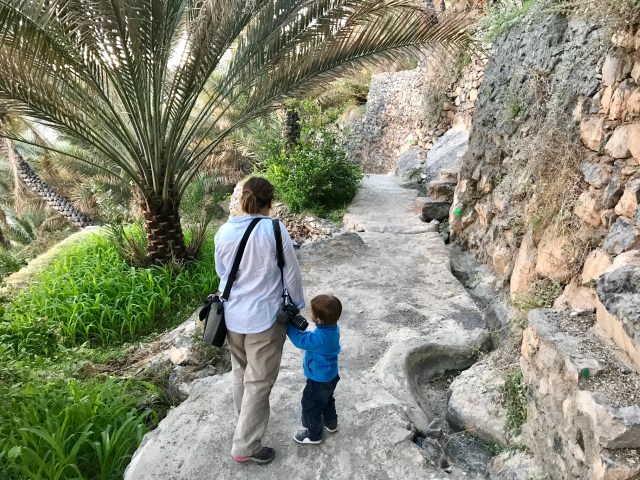
Shortly before dark we made it back to our accomodation of the night: Misfah Old House. This was the most authentic accomodation we had during our stay. The rooms respect the traditional way of sleeping, with matresess on the floor. We had a Master Bedroom that came with an en suite batroom but most rooms share bathroom facilities. The hosts are very kind and genuinly care about the few guests that they host. Dinner was tasty and with tipical dishes of chicken and fish with rice. We can really recommend the experience of this guesthouse if you want to sample omani hospitality.
Day 5: Misfah – Al Hamra – Wahiba Sands
In the morning we drove to Al Hamra village. We spent more than an hour walking into the old village and also visiting a living museum in a traditional Omani house: the women will show you the ancient methods to cook bread, prepare coffee and crafts. Around the corner from the living museum there is another house that can be visited, the oldest one in Al Hamra. Here you can climb to the roof and have some lovely views of the mud houses as well as some explanations on the local life, importance of frankinscence and omani customs.
After Al Hamra we headed to the desert camp at Sama Al Wasil in the Wahiba Sands. Count about 3 hours for the drive down. In Wahiba Sands, our driver was experienced with sand so he only stopped shortly to let some air out of the tires and then continued direclty though the dunes to the camp. If you have not driven on sand before, better contact the accomodoation so they can escort you from the main road and into the desert.

At 5 PM we did a sundown drive in the desert. It is a very popular activity and most resorts will offer this. Take a scarf and sun glasses for you and the kids. It if very windy and sand tends to go into the eyes, esoecially when kids are playing and running in the dunes.
Day 6 Wahiba Sands – Wadi Bani Khalid – Sur
After breakfast we headed to Wadi Bani Khalid, a spectacular oasis of palm trees and natural swimming pools set among the colorful rock formations of the Hajar Mountains. It takes about one hour 30 min to reach. Here you can spend the entire day, bathing and hiking.


If you want to use the opportunity to bathe in the sinkhole (you definitelly should as it is a unique experience) you will have to respect local customs. That means short sleeve bathing t-shirt and pants for both women and men. There are lifeguards on duty that also keep en eye on the dress code.Be prepared for a steep access to the water. The shore is mostly rocky, with a small flat portion before it drops suddenly to 5 meters depths. Getting the LO in the water and out was a bit of a challange. We mainly stayed with him on the flat rocky part as he is not yet old enough for a proper swim. After slipping on the wet rock once, he lost interest in going in the water in any event.
There is a 30 min or so hike to a nearby waterfall that starts a bit above the sinkhole and is clearly marked. As it was the middle of the day and the temperatures were nearing 30 degrees we preferred to stay close to the refrreshing wadi water and then having lunch in the shade.
In the afternoon we continued to Sur, to visit a dhow factory ( the traditional Omani boat).
Day 7 – Sur -Wadi tiwi – Muscat and potential 8th day in Ras al Jinz
We left the hotel in Sur and headed North. If you have an extra day and happen to visit in turtle hatching season (unfortunatelly, we were too late), 40 km South of Sur, on the coast is Ras al Jinz turtle reserve. You will have to wake up really early to be able to admire the turttles racing to the ocean at dawn. I saw good reviews of families having tried the experience. It might be worth however finding accomodation on the spot to reduce the early morning commute to the beach.
The route North goes between beautiful white beaches and the imposing mountain range of Eastern Hajar. During the morning we stopped for a walk through the palm groves and visited the villages of Wadi Tiwi. You can drive all the way in the wadi, however the road is sometimes narrow and bumpy. If you want to swim, you will have to wear the appropriate swimsuit.
Nearby is also Bimah Sinkhole, a curious crater carved in the rock and filled with clear water. It is located at the small Hawiyat Najm Park, by the dual carriageway from Muscat to Sur, and only 600m from the beach. Locally it is also known as Bait al-Afreet, and is a 40m wide and 20m from the surface. There are toilet facilities at the small park, and the area is popular with families for picnics. There are no bars or restaurants, so bring your own food and plenty of water if you plan to spend more time there. Also, access is through a series of steps so do not bring a stroller.
Days 9 and 10 -Relax at one of the lovely seaside resorts of Muscat
There are a few lovely resorts where you can enjoy the sea before getting back home. We chose Muscat Hills Resort, a former diving center now revamped into a series of beach huts. It is a small one compared to the Shangri-La, just accross the bay. We preffered it like this, as the atmosphere was more intimate and the hut was steps away from the beach. There were many families with young kids wrapping up their Oman or Muscat tours here even if there were no kids club or other kids dedicated activities except for enjoying the sandy beach.
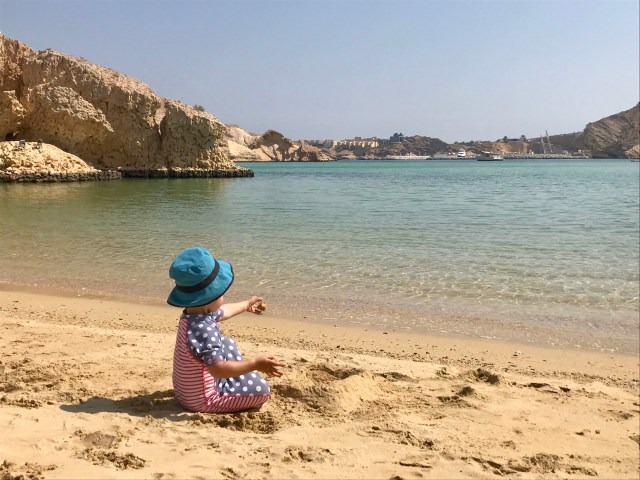
Acoomodation is in individual huts of a decent size. They are quite dark inside but this is also the keep the heat out during the day. They have moskito nets and large double beds. The furniture is basic and keeps with the local style. We found the service authentic and genuine and they were quick to address some small issues with the hot water during the first day. Toilet and shower are outside which reminded me of Bali.
The food was very good for both lunch and dinner. Especially dinner a la carte was a very nice choice as everything we tried was really outstanding and prepared with great care. Even if the prices were resort-level we did get some huge portions so actually did not have to order starters or an additional dish for the toddler as three of us could definetelly fill up with two mains. We can really recommend this place for a couple of days of sun worshiping and sand castle building before heading back home.
The downside of the resort is the remote location. If you have no car, you will be dependent on the transfers organised by the hotel and that can be a bit steep in price. But this is true for all the resorts in this side of the town, including the Shangri-La. Also, there is no shop on site so do stock up before on swim diapers, moskito repellant or other essentials.
Have you been to Oman? What is your favourite part of the country?
Happy travels,
CGK

 Travel Tales and Teddy Bears