Transfagarasan, the name of the road that links the South part of Romania with Transilvania was made famous in Western Europe by the British TV show Top Gear where it received the title of “best road in the world”. But even before gaining this notoriety, it was considered one of the most spectacular roadrips in Eastern Europe for its hight and beautiful views. Tourists from all over the world are now going to Romania to drive this 90 km stretch of road that goes up to an altitude of 2000 km and crossing the Southern section of the Carpathians.
As we recently found ourselves in Curtea de Arges for a family event, I wanted to write a post about the most interesting touristic attractions you should check out in this area. If your kids are used to longer car travel, this will be a great adventure to share as a family. As we did the road from South to North, the attractions follow the same order.
A bit more about the Transfagarasan road
Transfăgărășan road or DN (national road) 7C starts from the village called Bascov, in Argeș county, near Pitești. The road winds its way up and down the mountain, between the highest Carpathian Peaks of Negoiu and Moldoveanu and ends in the village of Cârțișoara, 50 km from Sibiu and 104 km from Brasov. The highest altitude reached is 2042m at Balea Lake.
A part of about 27 km from the road is closed completely to trafic for about 8 months per year, from end October till about end May due to risk of avalanche. This postion is located between km 104 (Piscu Negru – Arges) and km 130,8 (Bâlea Waterfall – Sibiu). While the road is closed on its highest portion, Balea Lake can be reached by cablecar from the Balea Waterfall only. This means, in Winter, it can only be reached if driving from North to South and not the other way around.
Curtea de Arges Monastery
If you have travelled to Romania before, you prabably have seen a fair amount of religous architecture. The North Moldova region is particularly well known for its monasteries and churches. This particular monastery is one of the most visited as it serves as a resting place for the members of the Romanian royal family. It was built in the 16th century and its construction is surrounded by several miths and legends, including the one of Builder Manole and its wife Ana who were sacrificed for the building to keep standing till this day. The monastery can be visited between 9AM and 17PM during winter and 8 AM and 20 PM in Summer. Access is easy, even if you might have to lift the stroller over a few steps at the entrance.
Poenari Fortress
Poenari Fortress is a monument from 14th century, located on one of the mountain peaks above the Arges river valley. The fortress consisted of 5 defence towers. Today, you will only be able to admire the ruins of their walls, 2-3 m thick. It was a residence of Vlad the Impaler, the hystorical figure at the basis of the fictional character Dracula. Unfortunatelly access is really difficult if accompanied by kids as you need to climb 1.480 steps to reach the top. Once you reach the top, you will also be rewarded with a beautiful panorama of the Fagaras mountains. It is opened between 9 AM and 18PM.
Vidraru Lake and Dam
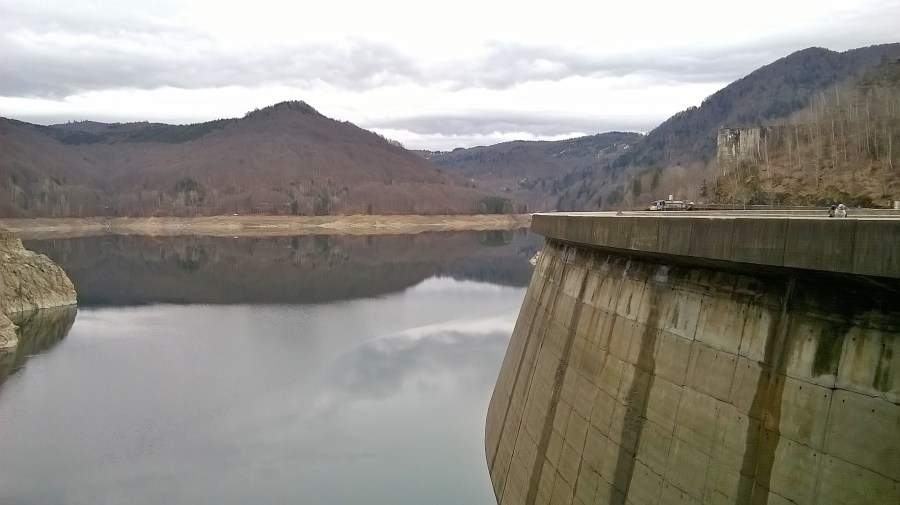
Both the lake and the dam figure proeminently in Romanian geography books. It is a well known location, in particular for the hight and length of the damm that was constructed in 1965, and was considered a major ingeneering feat of the communist era. To admire the sweeping views of the damm and Fagaras Mountains, you should stop at the Belvedere platform, located at a higher elevation after you cross the damm, on the right side. Above the platform, you will spot a statue of Prometheus, holding a lightning bolt above his head. Between 15 April and 5 September you can take a boat cruise on the lake. It lasts about 40 min and to access the pier you will have to go down a flight of stairs next to Posada Vidraru Hotel. You can also get your ticket and information on the schedule at the Hotel Reception, after you cross the damm.

Capra Waterfall
The waterfall is located on the South side of the mountain at 1960 m. It can be admired from the road, and if there is still a parking possibility, from a small bridge that located in front of the waterfall. it is 40m high and the water is supplied by a glacier lake. It almost never freezes due to the amount of water falling all the time. It is a nice place for a short brake before the final ascent to Balea Lake. However parking might be a challenge as there is no designated parking area.
Balea Lake
Probably the most visited place on Transfagarasan is the Balea Lake. It is the highest point on the road, at above 2000m. It is a glacier lake with a depth of about 11 m. The area around the lake is a protected reservation. In winter, local craftsmen are building the only Ice hotel in Eastern Europe on the shores of this lake. They use a bricks, huge ice blocks from the lake. It operates only until about March, once the ice starts to melt. It has about 16 rooms, a restaurant, a bar and even an ice church. There are other accomodation options in more traditional chalets or guesthouses around the lake. As in winter the road portion giving direct access to Balea Lake is closed, you can only access the Ice Hotel via cablecar from Balea Waterfall on the Northside of the Fagaras Mountain.
Thanks for stopping by. Happy Travels!

 Travel Tales and Teddy Bears